Navratri – Festival of Divine Energy
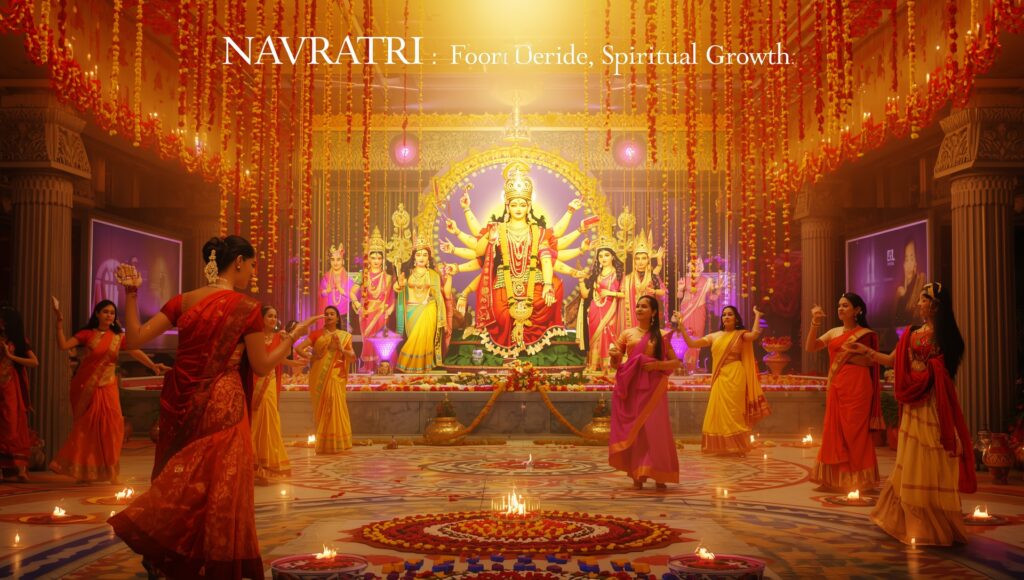
Festival of Divine Energy Navratri is one of the most adored festival celebrations of India it is not an event of cultural significance that includes dancing, music and ceremonies. It’s a deep spiritual experience that embodies victory of goodness over evil, the triumph of light against darkness and the awareness of ignorance. In the devotion to God the Divine mother, Navratri is a call to seekers take a journey to self-purification and meditation as well as awakening the inner energies.
Since the beginning of time, sages and spiritualists have stressed the fact that Navratri isn’t just dedicated to worshipping goddesses Durga, Lakshmi, and Saraswati as they appear in divine form and, more importantly, about revealing the unused divine energy that lies inside the human being. Each night is a signification of a step towards the inner journey, which takes us away from our material world to a state of subtle consciousness and eventually integration with the divine consciousness.
In this post we’ll discuss the significance of Navratri as a spiritual practice by exploring the worship of goddesses, their inner strength as well as practicing fasting, meditation. It will also discuss the transformative power of worship.
Goddess Worship & Inner Power
The essence of Navratri is the worship of the goddess and Shakti which is the power source which runs all of the universe. Shakti doesn’t exist in isolation from our lives, but is the dynamic power that runs each living thing. Navratri offers the chance to acknowledge this energy, to respect it, honor the power of it and reconnect to the source of it.
The Divine Feminine Principle
Hindu philosophy explains that life is not complete without merging of Shiva (pure consciousness) and Shakti (divine energy). Shiva represents stillness, awareness as well as silence. Shakti represents moving, motion and manifesting. When it comes to Navratri festivities, people are devoted to the goddess regardless of her appearance and recognize her as the only source of strength, wealth in strength, power and liberation.
- Durga The guardian and destroyer of negativity and the symbol for courage.
- Lakshmi is the person who provides the world prosperity, wealth and peace.
- Saraswati represents the Goddess of wisdom, knowledge as well as the capacity to perceive.
By committing ourselves in self-dedication (bhakti) to these kinds of forms forms to these forms, we are able to increase their power within ourselves. The power of Durga encourages us to confront challenges, Lakshmi reminds us that the real wealth is derived through faith and gratitude and Saraswati motivates us to develop an increased consciousness.
Awakening Inner Power
Navratri is not just a time that celebrates the outside world, it’s is also a time to experience the inside. When we sing mantras, perform aarti, and then meditate it is a call to the dormant energy within. Spiritualists say it is activating the chakra kundalini or the force of spirituality that’s at the top of our spine. The more energy that is activated, it turns fears into hope as well as uncertainty into clarity, shrinking into strength.
This is why Navratri is considered to be a occasion to work on self-control as well as meditation. The festival reminds us that the true temple of our soul is in the inner goddess. is that awareness that nourishes our.
Nine Nights of Transformation
The word Navratri literally means “nine nights. ” Each night is a step in spiritual growth. The texts of the past say that the nine nights symbolize an important part of the soul’s transition from obscurity to awakening.
The Three Stages of Navratri
- First Three Nights – Durga
- This is a day to honour goddess Durga who symbolizes the eradication of negative tendencies.
- In terms of spirituality, it’s the chance to rid yourself from anger, greed and jealousy. fears and egos.
- The same manner that Durga is capable of defeating Mahishasura’s monster, we’re required to take on our personal enemies.
- This is a day to honour goddess Durga who symbolizes the eradication of negative tendencies.
- Second Three Nights – Lakshmi
- When negativity is gone and the heart is opened to receive blessings from God.
- The celebration nights are devoted to goddess Lakshmi not just because she’s the cause of wealth and material prosperity, but also as the source of inner peace and joy.
- It’s about cultivating for selflessness and compassion.
- When negativity is gone and the heart is opened to receive blessings from God.
- Last Three Nights – Saraswati
- When purity and abundance is established the final step is awakening knowledge.
- Saraswati symbolizes of the awareness of consciousness, awareness and the greater level of consciousness.
- These nights encourage us to explore the practice of meditation, learning and also spiritual growth.
- When purity and abundance is established the final step is awakening knowledge.
The Victory on the Tenth Day
The 10th day of the lunar month is also known by the name of Vijayadashami or Dussehra is a symbol of victory for good over the evil. Symbolically this symbolizes the triumph of the mind (Shiva) along with the power of God (Shakti). This is a symbol of spiritual progress is all about the balance of dedication and the wisdom of a wise person, along with concentration and calmness, as well as being able to work by utilizing the consciousness.
Fasting & Meditation
The practice of fasting is among the most important practices observed at Navratri. A lot of people believe that it’s a way to quit eating. However, in reality it’s an act of worship that is meant to purify the mind and body.
Spiritual Meaning of Fasting
Food we consume affects not only our bodies but also our mental state. A tamasic, or heavy meals (like drinking meat or alcohol or foods that are refined) could cause blurred eyes and reduce concentration. In contrast eating sattvic-friendly light products (fruits or dairy and vegetables) can improve your clarity and tranquility. When you fast or follow the vegetarian diet in Navratri devotees can get their bodies prepared to become vessels for energy of the spiritual.
It also aids in training your mind to resist desire and the urges. The focus shifts to your internal mind, which makes the practice more powerful and effective.
Meditation & Inner Awareness
Along with practices of fasting the practice of meditation and contemplation during Navratri can be a powerful way to keep dedication at your thoughts. The repetition of mantras such as “Om Dum Durgaye Namaha” or “Om Aim Saraswatyai Namaha” is not only a way to honor the goddesses and aid in connecting our minds to the gentle energies of God.
breathing exercises (pranayama) as well as meditation can be a wonderful means to awaken the energy lost and to bring the body and mind into harmony with the soul. If done with a committed person it can lead to an increased sense of awareness as well as a feeling of calm.
Devotion as a Path of Transformation
Navratri is an opportunity to highlight the importance of commitment (bhakti) to the development of the spiritual. It isn’t an act of blind faith, but rather a real belief that is rooted in God that is in Heaven. If we put our own self-centeredness in front of the goddess, we’re allowing divine grace to flow through into our daily lives.
In observing the rituals of prayer or fasting through prayer, meditation and rituals, we gradually change our identity from only individuals, and being part of a larger global picture. The process of change is fundamental to spiritual growth.
- It aids in cultivating humility, and to eliminate self-importance.
- Awareness of oneself provides clarity and strength.
- Energie (Shakti) The power which inspires us to be brave and kind.
In combination, these could bring us closer to our own self-realization this is the final goal of our existence as humans.
The Role of Shiva in Navratri
Although Navratri is mostly an occasion to celebrate the goddess however, it is also tied to the presence of Shiva. In similar fashion, Shakti cannot exist without Shiva This festival serves as an opportunity to remember the relationship between the energy of consciousness and.
The symbolism of yoga Shakti symbolizes the rising energy (kundalini) as a shape of kundalini as well as Shiva is the highest focus of consciousness in the central chakra. The intention is the reason for Navratri exercise is to fast and meditate as well as a desire to be joined by Shakti as well as Shiva within.
It is in the moment when energies and consciousness merge, a person seeking the liberation (moksha). That’s why Navratri isn’t only a celebration however, an opportunity toward spiritual enlightenment.
Navratri in Daily Life
The nine nights are a significant time for worship, their teachings can be applied throughout all of the calendar year. The importance of Navratri lies in how it integrates the traditions of Navratri in daily life
- Encouraging courage in the form of Durga is faced with challenges.
- Reigniting gratitude like Lakshmi is abundant and to the apprehension of.
- Seeking wisdom like Saraswati in every action.
- Awareness of balance (Shiva) through balancing energy (Shakti).
If the practice is done regularly, the Navratri celebration is no longer just a celebration, but it is a way to practice devotion in addition to consciousness and connection.
Conclusion
Navratri is more than an event that’s filled with lights, music and dancing. It’s a spiritual pilgrimage lasting nine nights that gives individuals the opportunity to cleanse them of any negative energy and strengthen their faith, rekindle the power within them and be connected to the spiritual energy that’s Shiva and Shakti.
By adoring Goddesses by watching the goddess and fasting in a conscious way while praying and meditating in celebration of the unity of the mind and energy, We can observe the fact that Navratri isn’t only an event for celebrations on the outside it is also about inward spiritual transformation.
If you’re capable of comprehending the significance of Navratri as a religious ritual is unchanged. The festival shows us that real monsters dwell in us and it is the real Goddess. The goal is to conquer the first one and bring forth the second. This which is the primary goal of the holy celebration.